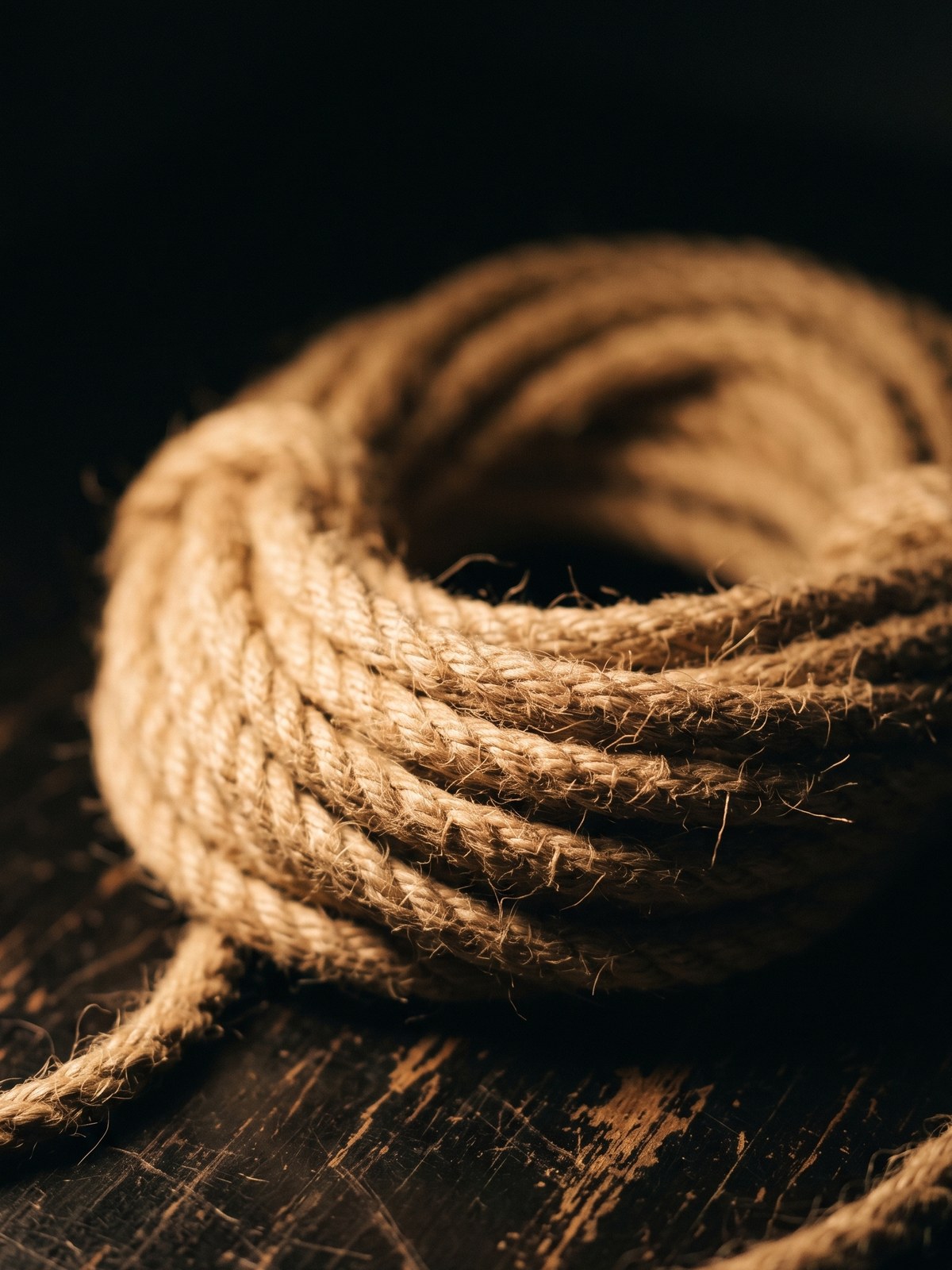
Rope as Language - Shibari Beyond Decoration
Jute makes a particular sound as it draws through a bight, dry and slightly rough, and most guests hear it before they feel any pressure at all. The first wrap goes across the shoulder blades. Shoulders drop a centimetre, unbidden. Somewhere between the second and third wrap the conversation stops being verbal, and what replaces it is more accurate than speech. Nothing decorative has happened yet. Everything important already has.
Rope reached Europe mostly through images. Kinbaku has a long and contested history in Japan, tangled with theatre, photography and the erotic press, and what travelled westward was largely the photograph rather than the practice around it. That is not a complaint about aesthetics. Beautiful rope is worth making. But a photograph is one frame out of something that unfolds over an hour, and the frame keeps the shape while discarding the breathing, the adjustments, the quiet checks, and the moment a wrap came off because a hand went cold. Social media compresses this further. A pattern whose safe placement took three years of study looks, on a phone screen, like something copyable on a Friday evening. The gap between the image and the craft is where most injuries live.
It helps to be plain about what rope is for. In my practice it is not ornament applied to a body, and it is not a test of how much someone can withstand. It is a way of speaking to a nervous system without using words, of asking a question the mouth would answer far too quickly. Constraint is the grammar. Tension is the tone. And because it is a language rather than a procedure, the same tie on two people says two different things. There is no wrap that reliably produces surrender, and no sequence you can run and trust to work. What the rope does depends on who is inside it, which is why I have never managed to teach this as a set of steps.
A single wrap across the lower ribs changes what breathing feels like. Not dramatically, and not dangerously when it is well placed, but enough that the person wearing it becomes aware of an action they have performed unconsciously since birth. Fix the arms and attention has nowhere ordinary to go; it turns inward, or it comes to me. That is the actual mechanism. Rope edits perception. It narrows the field until small things become large: the temperature of the floor, the sound of my footsteps moving behind them, the half-second before the next wrap lands.
Tension is where beginners misread the language most often. Tight is not the same as secure. A tie that grips hard in one narrow band is less stable and considerably more dangerous than one distributing load across a broad surface, and it also says something cruder. Well placed rope feels like being held by a decision. Merely tight rope feels like being squeezed by an accident. The conversation also runs both ways. The person in rope answers constantly, in weight shifts, in the depth of a breath, in a shoulder that rolls forward half a centimetre. My work is to read those answers and calibrate faster than they could be spoken. Precision here is not a flourish. It is the whole of it.
And here is the part that photographs never show. The nerves of the arm sit close to the surface at several points, and rope finds them with unhelpful reliability - the radial nerve on the upper arm, the brachial plexus near the armpit, the ulnar nerve at the inside of the elbow. The radial takes the worst of it: in a 2023 case series of rope bondage injuries, it was the nerve involved in nine of the ten people described. Numbness is not a sensation to breathe through. It is information. Any loss of motor function, a thumb that will not oppose, fingers that will not close, means the rope comes off immediately and not at the end of the pattern. Compression injuries sometimes resolve in days. They can also take months, and some people never quite get the feeling back.
Chest harnesses carry a different risk, and it is the one that deserves the most seriousness. A tie loading the ribcage, or a position that folds the torso, can restrict breathing to the point of collapse, quietly, and without the affected person being able to tell you. Nobody in rope is left alone, ever, not for a moment, not to fetch a camera. Alcohol and rope do not belong in the same room. Suspension in particular is not a beginner's craft, whatever a fifteen-second video implies, and the most common sentence preceding an accident is that it was only going to be for a photograph.
Some of this is not a question of technique at all, but of conditions. People who work in isolation, or who fear scrutiny, do not build strong safety cultures; they build silence, and in silence injuries go unreported and unlearned from. My work on the board of BesD e.V., the German professional association for erotic and sexual services, keeps returning to this point. Professional standards need a professional field to live in. Education, peer criticism and the freedom to say openly that something went wrong make a craft safer over time than any individual's skill ever could.
Rope is a language, and like any language it can be spoken beautifully and still say nothing. In private sessions I care far less about how a tie photographs than about what it makes possible: a quality of presence and attention a person cannot reach alone, held inside a container that is genuinely safe. Learn the anatomy before the aesthetics. Learn to read a breath before you learn a pattern. The images will come, and they will be better for it - but the good ones were never the point.
Next: How to Choose a Professional Dominus - Reading the Signals Before Your First Booking →
← Previous: Negotiation as Intimacy - The Conversation Before the Session