The Ethics of the Photograph - Why I Decline More Images Than I Take
A message reached me nine days after a session, from a guest who had chosen, carefully and in daylight, to be photographed. 'Would you delete the images? Nothing has happened. I simply thought about it again on the train, and I would rather they did not exist.' I deleted them that evening and wrote one line back to confirm it was done. No reason was owed to me, and none was asked for. That is close to the whole of my policy on photographs, and it belongs at the beginning rather than the end: an agreement about images is narrow, it is separate from every other agreement, and it ends the moment the person who gave it changes their mind.
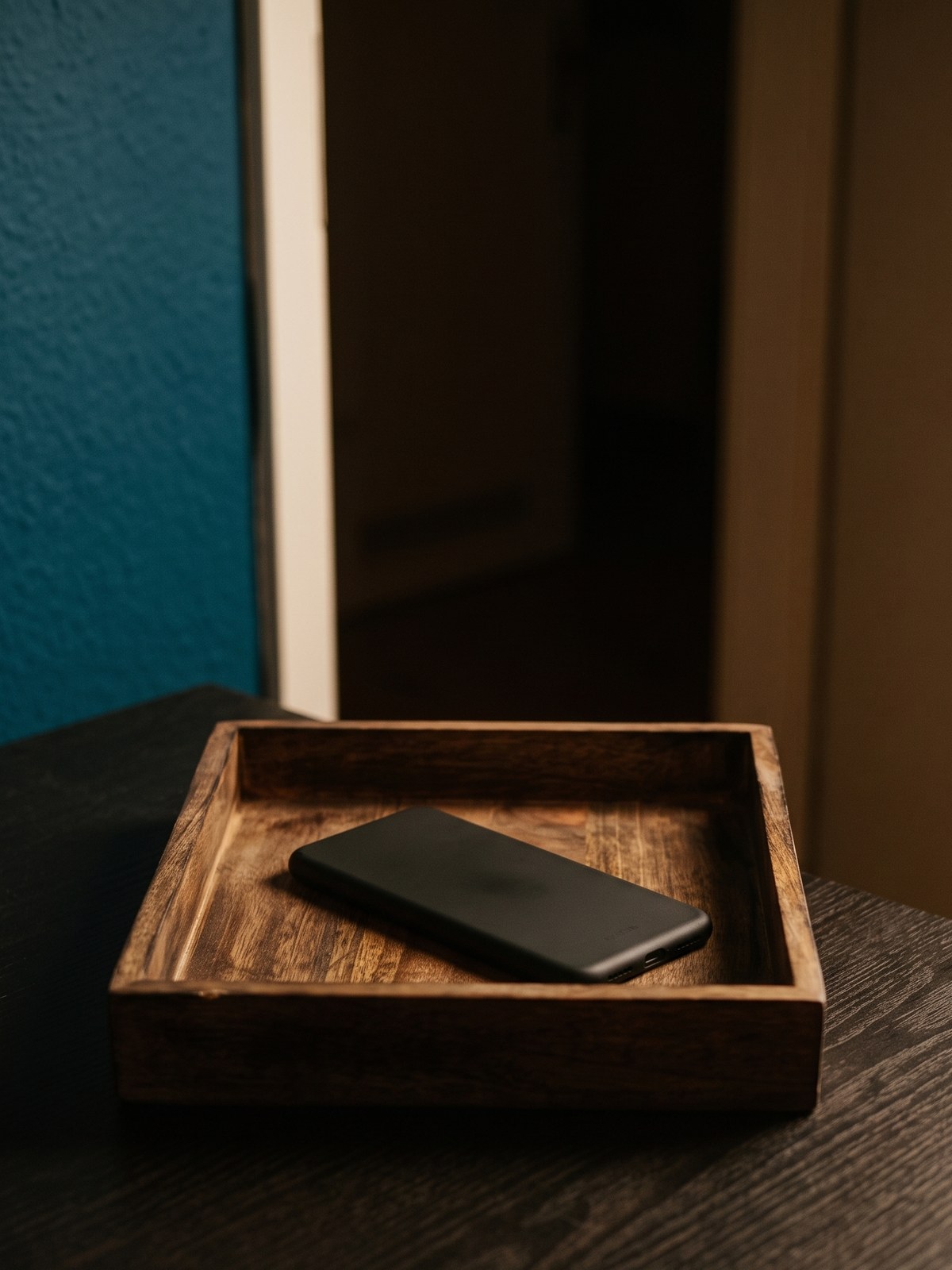
By the studio door stands a small wooden tray. Phones go into it, face down, before anything begins, and guests sometimes laugh at the formality of the gesture before they set the device down and feel something in their shoulders drop. On some evenings, though, I am the one holding a camera. Rope work photographs beautifully, and images travel further than any description I could write. A studio that never publishes becomes invisible; a studio that publishes carelessly becomes dangerous. Both failures are real, and the second one cannot be repaired. So the question in this work is never whether anything is recorded. It is who decides, how narrowly, and for how long.
Berlin makes this concrete. My guests include people whose faces are known in courtrooms, classrooms, hospitals and boardrooms. Some are married in ways their marriage has agreed to. Others are simply private, in the ordinary way that everyone is entitled to be. A photograph of a rope harness is not scandalous to me. In the wrong inbox it can end a career, a custody arrangement, or a friendship of thirty years.
Here is the distinction most people collapse. Consent to a session and consent to an image are different agreements, made by different parts of a person, carrying different risks. When a guest agrees to be bound, the consequence lives inside the evening and inside their own body. When a guest agrees to be photographed, the consequence lives in file systems, in backups, in the strange permanence of anything that has been copied once. The first can be ended with a word. The second cannot.
So the image agreement is made separately, in daylight language, before arousal enters the room. What is in frame. What is cropped. Where it may appear, and where it may never appear. Whether a face, a tattoo, a wedding ring or a distinctive wall in the background is permitted to be visible. Vague permission is not permission. 'You can use it' is a sentence I decline to work from, because it hands me a decision that was never mine to make.
The moment at which a yes is spoken matters as much as its content. A yes given in the golden half hour after a scene is not worthless, but it is not durable either. The nervous system is generous then; it agrees to things the Monday morning version of that person would weigh differently. So consent to an image is confirmed later, in a plain message, days afterwards. If it is not confirmed, it did not happen. And it can be withdrawn at any point, for any reason, with no explanation owed.
This is where discretion stops being a courtesy and becomes an obligation of the trade. Sex work in Germany is legal, and it remains stigmatised, and those two facts together create the whole problem. Research from several European countries keeps finding the same pattern: the harm rarely comes from the work itself, it comes from exposure. That is why standards around data, images and the protection of guests are a live subject inside BesD, the German professional association for sex workers, an organisation that has spent years making exactly that argument in public. Discretion is infrastructure.
The risk calculus is asymmetric, and the asymmetry is what people underestimate. A good photograph gives a guest a memory object, a private proof that the evening was real. A bad outcome gives them a conversation with an employer, a lawyer, or a child. One side of that ledger is a pleasure. The other side is a life. Weighed honestly, the sensible answer is usually no, and I have learned to say it before the guest has to.
Which is why I decline far more photographs than I take. Not out of caution as a pose, but because most of them would add very little and could cost a great deal. Some evenings deserve an image. Most simply deserve to have happened. Declining is itself a form of care: it removes the quiet pressure a guest might feel to perform an openness they do not actually want.
The tray by the door stays where it is. What happens in the room is held by two people and by the room, and that is usually enough. Memory is a poor archive and an excellent one; it fades, it distorts, and it never leaks. If you carry a public life, say so on the first evening. You will not be asked twice, and nothing will be recorded that you did not choose in daylight.
← Previous: Beginning Later - Age, Experience and the Desire That Waited