Twenty-Four Hours - The Reckoning of Nicole
Six months earlier, she had left my cellar with a new name and a whisper: "I am Nicole."
She thought that was the ending. It was a file left open.
In January I had taken ten hours to dismantle a woman who came looking for fear and found method instead. In July she came back for twenty-four. Same cellar, same uniform, same colonel. But this time she was not arriving as a candidate. She was arriving as a suspect.
The department had been watching her.
16:20 - The Door Code
She was twenty minutes late.
There was a code for the door, and she had been given it days in advance. Not a number. A tongue-twister: Zehn zahme Ziegen ziehen zehn Zentner Zucker zum Zoo. Ten tame goats haul ten hundredweight of sugar to the zoo. Say it cleanly and you are expected. Stumble and you are something else.
She stumbled.
Agent Christian - played by my colleague - met her at the door, took her in, and told her to sit. She put her bag down on a chair.
The Oberst's chair.
Cheeky. And useful. Brattiness is not an obstacle in this work, it is data. It tells you exactly where the resistance lives and how much of it is performance. I let it stand. There would be time.
16:25 - Silence
I let her wait five minutes for me, which is nothing, and felt like a great deal.
When I came through the door as Oberst von Halle, I said nothing at all. Silence is the cheapest instrument in the room and the most reliably underestimated. It costs you no energy and it costs the other person everything, because they will fill it. They always fill it.
Then I broke it.
"Six months ago I gave you a chance. A chance to stay alive. I find myself reconsidering that decision."
16:30 - 17:30 - The Examination Room
I took her down to the Prüfungsraum, put a test in front of her, and told her she now had one hour left to complete it.
Then I left.
The test was not the test.
Beside her on the table lay a folder. A pen was clipped over the edge in a way that held the cover shut, and a slip of paper was clipped under the pen so that opening the folder would drop it. Anyone who touched it would leave a signature they did not know they were writing.
Inside the folder were Agent Christian's surveillance reports. Dates, times, locations, transcripts of intercepted messages, photographs. A café. A hotel bar. A car park behind a shopping centre. A bench by the Spree. Envelopes, a USB stick, a folded sheet of A4 passed between the pages of a library book. Three names: Ruslan Boshirov, Alexander Petrov, Anna Kovenko.
An hour alone in a room with a sealed folder full of your own condemnation. There is no version of that hour in which a person behaves innocently.
17:30 - 17:50 - Are You Stupid, or Is This a Joke?
I came back for the answers.
The paper had dropped.
Her test answers were, in places, absurd. Deliberately so. So I asked her directly: "Are you stupid, or do you see this as a joke?"
"Maybe a bit of both."
She spent that entire session trying to make me erupt. Louder, ruder, more provocative, always pushing towards the moment where the man in the uniform loses the uniform and becomes just an angry person. That is what she wanted, because an angry man is a man you understand. An angry man has lost control, and if he has lost control, you still have yours.
I did not give it to her.
Instead I worked through the photographs. Headshots first. "Do you know this person?"
"No."
"And this one?"
"No."
Then the reports, read aloud in a flat administrative voice, the way you would read out a stock inventory. She had an answer for all of it: there is no proof, that is wrong, that cannot be.
Then the photographs of her. With them. Handing something over.
"Fake. That is not me."
And still she pushed for punishment, because punishment would have been a relief.
So I got louder. Not out of control, but out of patience, which is a different sound entirely, and I told her what I thought of her. Then I leant over her, close, and looked down into her eyes.
"Now I am scared," she said. "Even though I have to laugh." And she laughed, and told me again that she was scared.
Both of those things were true. That is usually the moment.
I said the code sentence.
"Schmerzen helfen zu verstehen." Pain helps you understand.
Spezialist Stahlbach had been standing at the entrance to the cell room the whole time, waiting for exactly those four words. He took her, put a hood over her head, cuffed her, and the two of us walked her into the box.
Then we shut the door and went upstairs.
17:50 - 18:45 - The Sound of What Is Coming
We were not quiet.
She was hooded, inside a box with the door shut. She saw nothing at all for an hour. Everything that follows, she built out of sound.
Heavy boots on the stairs. Chains dragged across concrete. Metal set down on stone, close enough to the box that she could place where it lay without ever seeing it.
Then the boots came down again, more than one pair, and something heavy and hollow was dragged across the floor and set down directly in front of her. A pause. Then water, running into it, and running, and still running - far longer than filling a bucket takes, long enough that she could hear the pitch of it change as the level rose. Then the slap of a hand through the surface. Then nothing.
We never told her it was a tub. We let her fill it in herself.
You cannot make someone imagine a thing by describing it. Describe it and they analyse it. Let them hear it being prepared and they build it themselves, and what they build is always worse than anything I would have done. That hour of noise was the most efficient work of the day, and none of it touched her.
18:45 - 19:00 - The Water
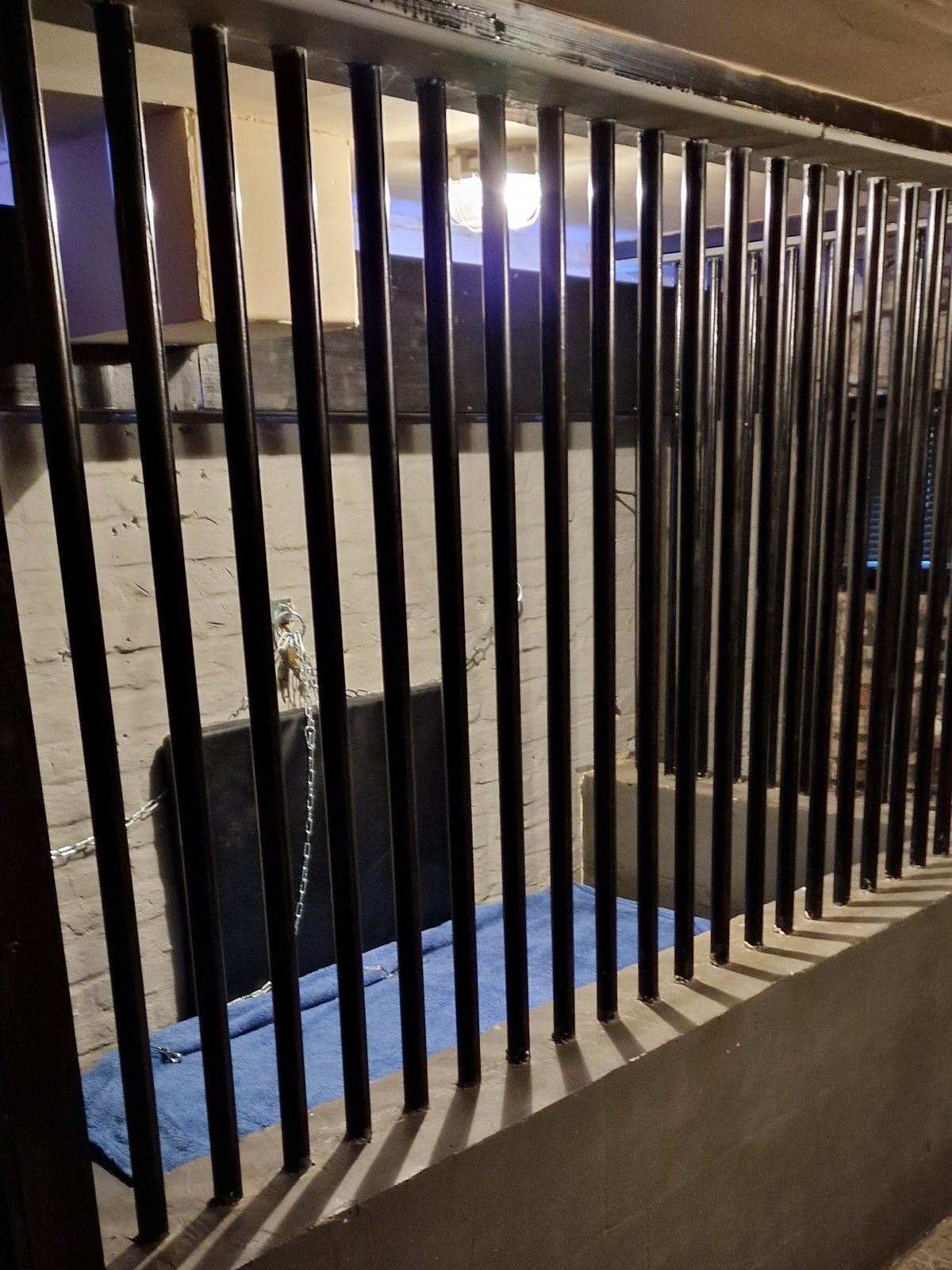
We opened the box. Shoes off. Crawl out. Hands cuffed, feet cuffed, chains run to the wall.
Then we took her to the tub and held her head above the water.
"What do you have to say about yourself?"
And there it was, the first real thing she had given us in two and a half hours: there had been a man. She had been drawn in. He had turned out to be a Russian agent.
"How could you be so stupid?"
"I am weak."
That is the Recognition phase, and you do not push through it, you let it settle. So I told her instead that her case had been passed upstairs, to the psychological department, and that an expert was being sent.
"Until he arrives, we can pass the time. And I will see what I can get out of you."
Back in the box, to think about her errors.
19:00 - 19:15 - The Phone Call She Was Meant to Hear
Spezialist Stahlbach took a call standing right next to the box.
"We have a piece of shit down here who is not going to survive tomorrow. The Oberst is out. Come round and play."
On the other end was Spezialist Samael, who said he was on his way.
Nobody spoke to her. Nobody had to.
19:15 - 19:45 - The Pulley
Two specialists, one prisoner, no colonel.
We took her out and made her crawl across the floor with her hands cuffed behind her back, which is not elegant and is not supposed to be. Then we hauled her up, and one of us said the useful sentence: "Take her upstairs. There is more room up there."
More room is a promise, and not a kind one.
Upstairs, she crawled to the centre of the room and we hung her by the arms from the electric pulley.
We started light. Impact, measured and unhurried, opening the body up rather than shutting it down - the low end of the range, building by degrees, with two of us watching what came back after every stroke. That is how you find the ceiling without hitting it.
And then her body opted out.
A wave of weakness, the kind that arrives without permission. This is the part of the craft that never makes it into the fantasy: the constant, unglamorous monitoring underneath everything else. Colour. Breathing. Hands. Weight distribution. The difference between a person who is frightened and a person who is going down.
We had her out of the pulley and into the cell immediately.
At 19:57 Stahlbach went down and put a bucket in the cell with her, because prisoners do not get bathrooms and because a body that has been through what hers had been through needs the option. She was exhausted, and completely compliant.
Rest. Thirty-five minutes.
20:35 - 20:55 - Red
Here is the part that most session write-ups quietly leave out.
At around half past eight, while I was carrying a desk and a lamp up the stairs for the next act, she gave me red.
We had three levels agreed. Erbarmen - do not escalate, ease off, change direction, keep playing. Rot - stop, something is not right, let us look at it, the scene does not have to die. Kokosnuss - finished, out, done, no discussion.
She used red.
I told her I would be down in fifteen minutes to talk to her, and I was.
What she needed was not an adjustment. Four and a half hours in, the intensity had outrun her capacity. Nothing had gone wrong, in the sense that nothing had been done that we had not agreed. It had simply been more than she could hold, and she was honest enough and brave enough to say so, which is far harder to do at hour four than at hour one.
So I cut it. Softly, and without argument.
We let her sleep upstairs on the sofa. Not in the cell. Not in the box. Not in restraints. The role play stopped at 20:55 and did not resume until 06:55.
That decision cost us the entire architecture of the night. Sleep deprivation was designed into this session from the beginning: shifts, interruptions, a couple of hours here and there, the deliberate erosion that makes the morning work. I gave up ten hours of it, and with it the plan's whole middle movement.
I would make that call again every single time.
The uniform is a role. The responsibility underneath it is not.
06:55 - 07:30 - Just You and Me
In the morning we put her back in the cell and started again.
Spezialist Samael came down alone, cuffed her to the bars, and told her the truth of her situation as he saw it.
"The Oberst is not here. Stahlbach is not here. Just you and me. And until this psychological expert of theirs turns up, I can have my fun. They told me not to damage you too much."
Rope, to fasten her against the bars properly.
Then the knife.
I let her see it before I let her feel it, and I slid the flat of it slowly along her body while I told her, quietly, that I knew she was not going to leave this building alive, and that the knife had been waiting a long time for a day like this.
"Let us play a game. Take some time and think. I want an estimate. How long do you have left? Minutes? Hours? Days?"
"If you guess right, I will kill you quickly. If I win, I open you up and feed you your own insides, piece by piece, and I make very sure you stay alive for it."
Then I left her fastened to the bars, blindfolded, to do the arithmetic of her own death.
07:45 - 08:00 - Three Hours
She said three hours.
I told her she had underestimated me.
Then I cut away her t-shirt, and the lace body underneath it, and read her skin the way you read a file. Three tattoos: her husband's name, a line about the master of forbidden dreams, and the name of an island.
In an interrogation, everything is evidence. Especially the things a person chose to have written on themselves.
Back into the box.
08:30 - 09:00 - Lower Than Last Time
We opened the box, took her out, and walked her up the stairs to the interrogation room.
Headphones on, so that the world got quieter and smaller.
Caning. Threats. The knife travelling again.
Her pain threshold was measurably lower than it had been in January. That is physics, not a failure of nerve. Fear consumes the same reserves that pain tolerance draws on, and she had been carrying fear since the previous afternoon - through the evening, through a night's sleep that does not undo it, and into a morning that opened with a knife. A frightened body pays more for every stroke.
I cut away the rest of the lace body. She was down to her trousers.
Then back down the stairs and into the box. An hour and forty minutes.
10:35 - Finally!
At 10:35 I opened the box.
"Finally!" she said.
I shut the door again and went back upstairs.
Five minutes of work. Five minutes she experienced entirely differently.
10:40 - 11:45 - Dr Conrad Tiefenthal
When I came back for her, I informed her that she had just lost her opportunity to use the toilet, and that she would be crawling upstairs, blindfolded.
The second room had been prepared while she was in the box. A single desk. A single lamp. Every other light off. A hard seat for her. And a comfortable chair for the man who was coming.
We sat her down and took off the blindfold and the headphones.
Dr Conrad Tiefenthal came in. Forensic psychologist and analyst. Unhurried, courteous, faintly warm, entirely procedural.
What followed was a psychological evaluation, and it was the most invasive hour of the twenty-four, and it left no marks at all.
To ensure that she answered promptly, she was shown what happens when she does not. Dr Tiefenthal excused himself to fetch a coffee. Spezialist Samael had his fun with canes and whips. When the doctor returned, the room was exactly as he had left it, and so, apparently, was everyone in it.
She understood quickly. She needed two more demonstrations.
This is what good cop and bad cop actually is, and it is not the cliché. The design principle is simple: the good cop must never see anything. He must never intervene, never apologise, never acknowledge. He simply arrives in a room that is always calm and asks reasonable questions in a reasonable voice, and the subject learns that the only safe place in the building is the space around this man, and that the price of staying in it is answering him.
At the end of it, he closed his notebook and said he would consult with the Oberst.
Then we put the blindfold back on her, and the headphones, and gave her one song.
Her favourite song. The one whose words are tattooed on her skin. She knows it as industrial metal. We had it regenerated as a bright, jaunty ukulele cover, all sunshine and strumming, and we put it on a permanent loop and left her alone with it.
That was the cruellest thing I did in twenty-four hours, and it never touched her once.
12:15 - 14:00 - The Reckoning
Same room. Same desk, same lamp, same hard seat. She had not been moved since she crawled up there, and she would not be moved again.
I came back in uniform, as the Oberst, with the expert's assessment. Dr Tiefenthal came with me, and it was the doctor who read out the summary.
That was the point of him. He read it in the same flat administrative register the surveillance reports had been read in the evening before, because a verdict should sound like paperwork. But it came out of the one mouth in the building that had never raised itself at her, never threatened her, never left a mark on her. The courteous man who had spent an hour being the only safe thing she had was the man who now put her on the record. There was nowhere left to appeal to. The department's conclusion was not in doubt. Nicole had cooperated repeatedly and knowingly with a hostile service. The recommendation was the obvious one.
Then I walked her up the compliance ladder, one rung at a time.
Write this down: I confess. Just that. Now read it aloud. Now say it again without looking at the paper. Now sign it.
None of those steps is a large ask on its own, and that is precisely the point. Every small compliance makes the next one cheaper, and by the end of the sequence the words are not being extracted from her any more, they are coming out of her mouth in her own voice, in a room where she has just watched herself agree four times in a row.
Somewhere in that sequence, the fight went out of it, and what was left was true.
Then I changed everything.
I told her the sentence stood, and that it would not be carried out today. That the department had spent six months and considerable resources establishing exactly what she was, and that a corpse would be the least useful possible return on that investment. That someone who could sit in a hotel bar with Boshirov and not be noticed was worth a great deal more pointed in the other direction. That she had shown a kind of nerve, and that nerve is not something we can train into people.
"You are not the enemy. You are the asset the enemy thinks he has."
That is the whole trick of the reprogramming phase, and it works because it is emotionally accurate even when the story around it is invented. You take the thing the person has just confessed to, the thing they are most ashamed of, and you hand it back to them as the reason they are valuable. Guilt becomes usefulness. The way out of the shame is through service.
She took it. Of course she took it. After nineteen hours, being needed is the most beautiful word in the language.
I made her say it out loud. Loyalty, in her own words, to be written into the file.
And then, last of all, the question that had started all of this in January.
"Your name."
"Nicole."
14:00 - 16:00 - Coming Back
And then it stops.
The cuffs come off, the blindfold comes off, the room lights go on, and the man who has been carrying a colonel's insignia for twenty-four hours puts them down on a table and becomes a person holding a blanket.
Warmth first, then water, then sugar, because a body that has been running on adrenaline for a day is not going to be reasoned with until it has been fed. Then a hot shower, for as long as she wanted it, which was a long time. Then food, and a soft place, and no hurry at all.
Then the talking. My colleague came out of Christian, Stahlbach and Tiefenthal and sat down with us as himself, and the three of us went through it: what landed, what did not, what the night had actually been about, what she wanted to keep. She was shattered in the good way, the way that comes with clarity rather than damage. Her marks were checked and cared for. She was told, in plain language and out of role, what she had done well, and there was a lot of it.
Nobody was rushed out of that door.
Afterwards, when she had gone, I did the least cinematic thing imaginable. I peeled the uniform off layer by layer, drank something cold and chemical standing up in the kitchen, and stood in the shower long enough to stop being Oberst von Halle. Twenty-four hours of holding a role does not end with a flourish. It ends with gravity, and a very ordinary man cleaning a cellar.
Final Thoughts
A twenty-four hour session is its own animal.
Ten hours is a performance. You hold a line, you escalate, you finish. Twenty-four hours is a campaign, and a campaign has a night in it, and logistics, and shift changes, and a moment somewhere around hour five where the plan meets the human being and one of them has to give.
The plan gave. That is what it is for.
I lost the entire designed night to a single word, and the second half of that session was better than the first, because she came back into it having learned something that no amount of caning teaches: that the thing holding the knife would put it down instantly if she said so, and pick it up again just as completely when she was ready.
That is not a caveat to the intensity. That is the engine of it.
And the rest of it, the six months, the open file, the reports written and photographs staged for a woman who would only ever see them once, alone, in a room where she was not supposed to open the folder at all - that is the part nobody expects. Continuity does more work than any implement I own. She spent half a year knowing that the colonel still had her name in a drawer.
She came in as a suspect. She left as an asset.
And somewhere in between, for about twenty minutes on a Saturday evening, she was simply a tired woman on a sofa who had had enough for now, and that was allowed too.
Not everyone who comes to me knows what they are asking for. She did. Both times.
← Previous: Advocacy in Action - Speaking Up Against the Nordic Model